HOTEL GUIDE
How to Read a Thai Restaurant Menu: Essential Words, Dishes and Phrases for Travelers
A practical traveler’s guide to reading a Thai restaurant menu: cooking categories, key words, proteins, spice modifiers, vegetarian markers and simple Thai phrases to show servers.
Reading a Thai restaurant menu doesn’t need to be intimidating. Whether you’re at a Bangkok street stall, a family-run eatery or an upscale hotel restaurant, learning a handful of Thai words, ingredient names and polite phrases will help you order what you want, avoid allergens and manage spice. This guide gives the most useful words, sample translations and short Thai phrases to keep on your phone or print as a cheat-sheet.
Key Takeaways
- Recognise menu categories (pad, gaeng, tom, yum, khao, guay tiew) to spot the dish type quickly.
- Watch for hidden animal ingredients (nam pla, nam man hoi, kapi); use 'mai sai' to ask them removed.
- Use simple Thai script phrases for allergies and spice levels and prefer written requests for safety.
How Thai menus are organised
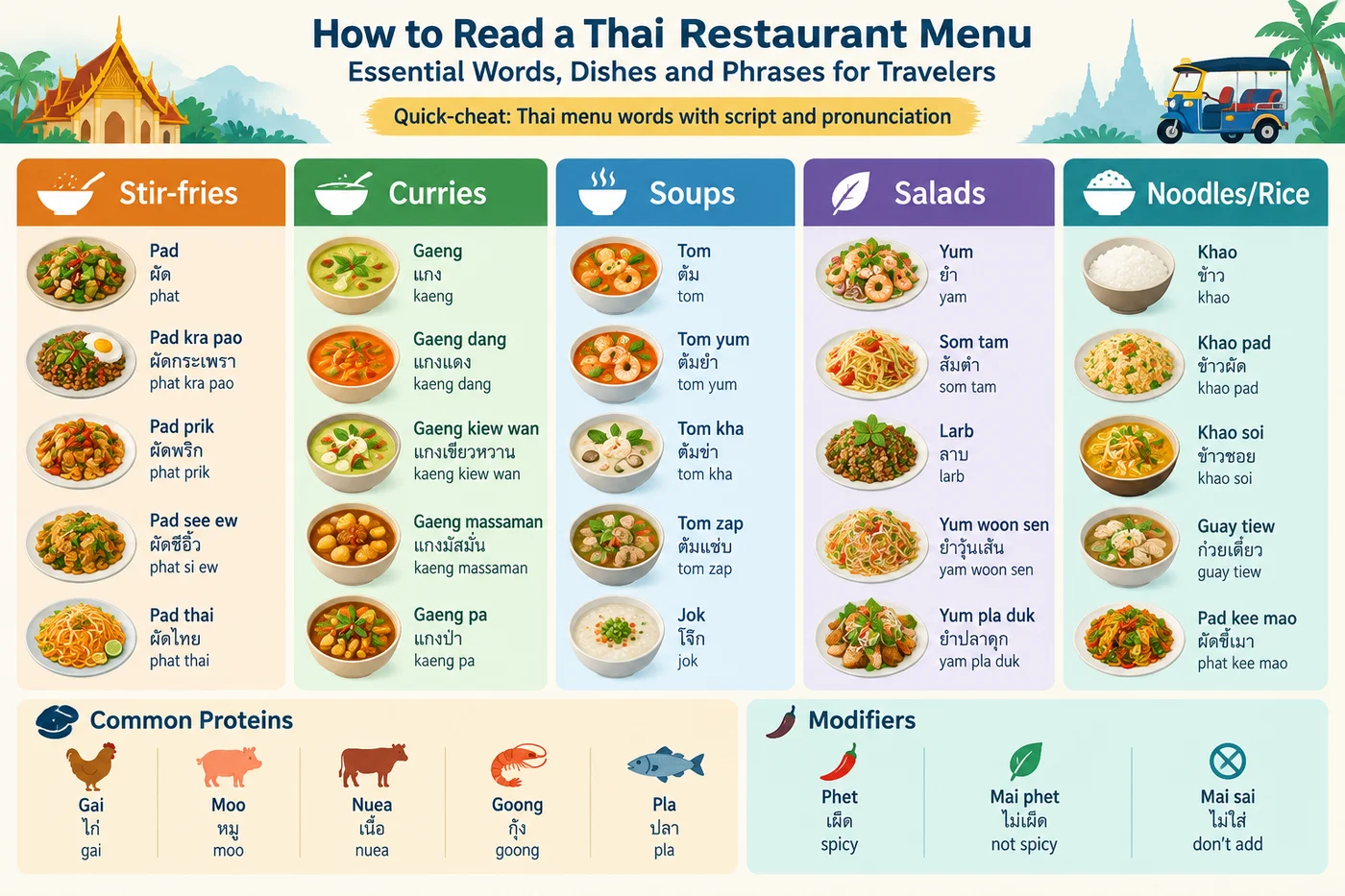
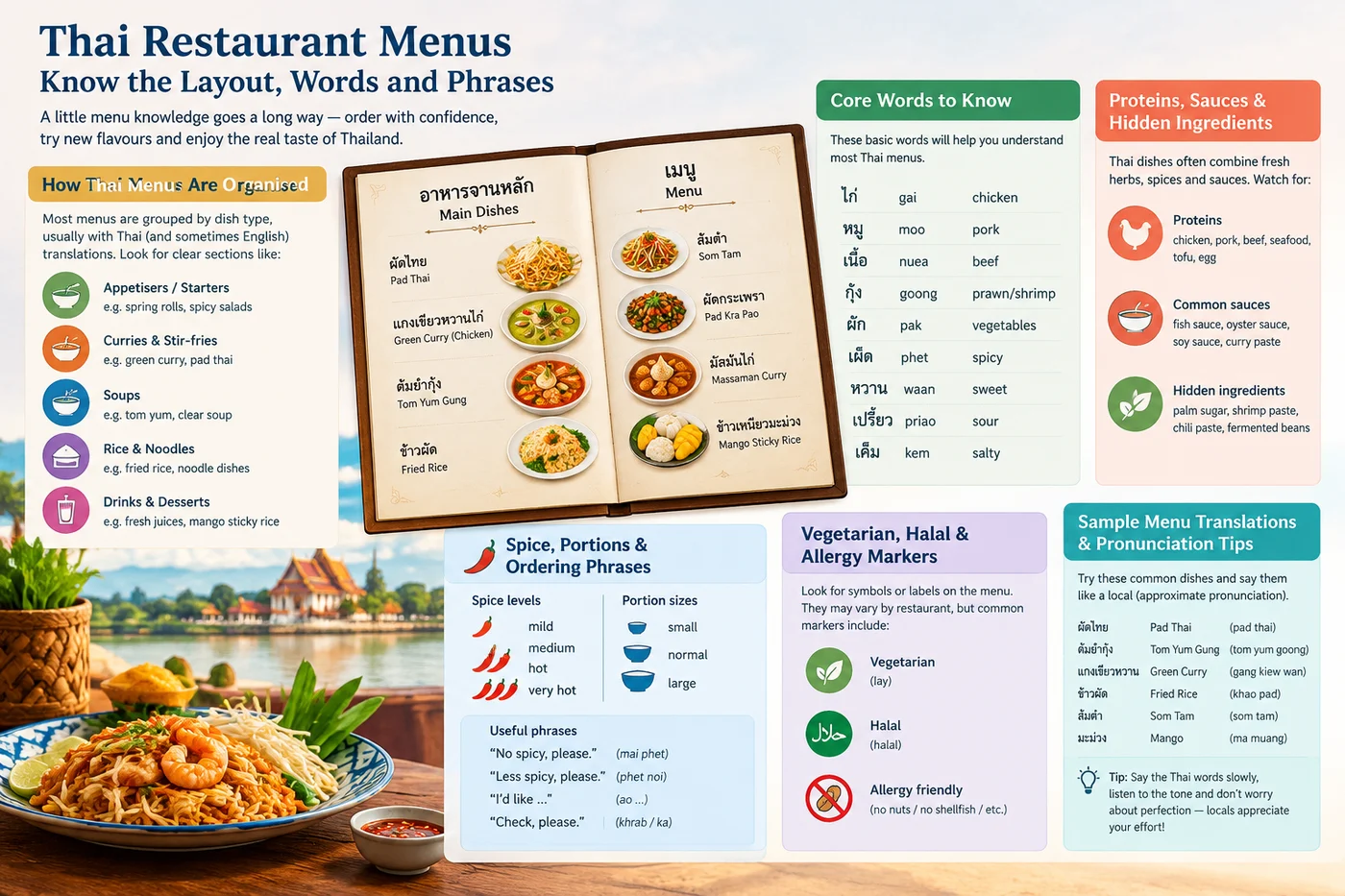
Menus in Thailand are often grouped by cooking method: stir‑fries, curries, soups, salads, then noodle and rice dishes. Within each group the dish name is followed by a protein variant (chicken, pork, beef, shrimp, fish). Tourist areas usually have English translations and photos; smaller local places may show only Thai script. Tip: scan for category words (see next section) and a photo—then confirm the protein and any sauces if you have dietary restrictions.
Thai restaurant menu: core words to know
Learn these short words and you’ll recognise most items on a menu. I’ve added Thai script and simple romanisation to show to servers.
- Pad / ผัด / phat — stir‑fry (e.g., Pad Thai)
- Gaeng/Kaeng / แกง / gaeng — curry or stew (e.g., Gaeng Daeng)
- Tom / ต้ม / tom — boiled soup (e.g., Tom Yum)
- Yum / ยำ / yam — spicy, tangy salad (e.g., Yum Woon Sen)
- Khao / ข้าว / khao — rice
- Guay tiew / ก๋วยเตี๋ยว / guay tiew — noodles
- Som tam / ส้มตำ / som tam — green papaya salad
Pronunciation tip: focus on the consonant start and the short vowel—'pad' sounds like the English 'pot' with a soft d, 'gaeng' like 'gang' with an ae vowel.
Proteins, sauces and hidden ingredients
Common proteins: gai / ไก่ (chicken), moo / หมู (pork), nuea / เนื้อ (beef), goong or kung / กุ้ง (shrimp), pla / ปลา (fish), khai / ไข่ (egg).
Hidden animal-derived flavourings are widespread: nam pla / น้ำปลา (fish sauce), nam man hoi / น้ำมันหอย (oyster sauce), and kapi / กะปิ (shrimp paste). If you avoid these, show the short Thai phrase: 'mai sai nam pla' / ไม่ใส่น้ำปลา (don't add fish sauce) or 'mai sai kapi' / ไม่ใส่กะปิ (no shrimp paste). For multiple items: 'mai sai nam pla, mai sai nam man hoi' — keep it short and show it written to avoid errors.
For authoritative background on common ingredients and menu decoding, see language and food guides such as Preply and WokFeed.
Spice, portions and ordering phrases
Spice is adjustable. Useful modifiers and short phrases to memorise or show:
- Phet / เผ็ด — spicy
- Mai phet / ไม่เผ็ด — not spicy
- Phet nit noi / เผ็ดนิดหน่อย — a little spicy
- Mai sai + [ingredient] / ไม่ใส่ + [ingredient] — don’t add [ingredient]
- Khor menu / ขอเมนู — may I have a menu
- Kor + item / ขอ + [item] — please may I have [item]
Portions: many places serve food family style. If you want rice on the side ask 'khao rap / ข้าวราด' or 'mai ao khao' if you don't want rice. For set menus or sharing, say 'gin ruam' / กินรวม (share) or ask if the dish is 'sufficient for one' — staff will often tell you how many people it serves. Use polite particles 'khrap' (ครับ) for men and 'kha' (ค่ะ) for women to smooth interactions.
Vegetarian, halal and allergy markers
'Jay' / เจ — indicates Chinese‑Thai vegetarian (often excludes meat, eggs, dairy and pungent alliums such as garlic or onion). Restaurants will display the red เจ on yellow backgrounds during the Vegetarian Festival or for menu items.
'Mangsawirat' / มังสวิรัติ — means vegetarian, but it may still include fish sauce or oyster sauce unless specified. For halal choices, look for official halal symbols or ask 'halal mai?' (ฮาลาลไหม?).
Allergies: for serious allergies bring a printed Thai allergy card. Short useful phrases:
- I am allergic to shellfish: 'Pom/Chan alergic khrang krap/ka, gin goong mai dai' — but it's safer to show the Thai sentence: 'ฉัน/ผมแพ้กุ้ง' (chan/pom pae goong).
- No peanuts: 'mai sai tua mamuang' / ไม่ใส่ถั่วลิสง.
If in doubt, choose hotels or established restaurants that understand special diets.
Sample menu translations and pronunciation tips
Quick samples to show or save on your phone:
- Pad Thai gai / ผัดไทยไก่ — Pad Thai with chicken (phat tai gai)
- Gaeng daeng moo / แกงแดงหมู — Red curry with pork (gaeng daeng moo)
- Tom yum goong / ต้มยำกุ้ง — Hot‑and‑sour soup with prawns (tom yum goong)
- Som tam pla ra / ส้มตำปลาร้า — Papaya salad with fermented fish (som tam pla ra) — avoid if you dislike strong fishy flavours.
Pronunciation tip: show the Thai script to servers; romanisation varies and can cause mistakes. A short written Thai sentence for allergies or 'not spicy' is the most reliable approach.
Practical Tips
Save a small printed card or phone screenshot with: 'ไม่เผ็ด / mai phet' (not spicy), 'ไม่ใส่น้ำปลา / mai sai nam pla' (no fish sauce), 'ฉัน/ผมแพ้… / chan/pom pae…' (I am allergic to…). Point at the menu photo and the card rather than trying long spoken explanations. Prefer hotels or restaurants for severe allergies. For more on street eats, see HotelForU's Bangkok street‑food guide as an internal reference.
Important Considerations
Romanisation on menus is inconsistent—rely on Thai script or a written Thai sentence for allergies. 'Vegetarian' may still include fish or oyster sauce; 'jay' is stricter but confirm. For life‑threatening allergies, avoid casual stalls and carry an allergy card in Thai.
Planning more of your trip? Browse our
Thailand Food & Restaurant Guides
for more practical Thailand food and dining information.
Final Thoughts
With a handful of words, a printed phrase card and a little confidence, you can read a Thai restaurant menu and order safely. Keep requests short, show written Thai when it matters, and enjoy trying new flavours—Thailand’s food scene rewards curiosity.
Sources & Further Reading
- WokFeed – Thai menu decoder
- Preply – How to order food in Thai
- OutThailand – Vegetarian and vegan food in Thailand
Transport schedules, fares and operating rules can change. Always verify time-sensitive details with the official operator before travel.