HOTEL GUIDE
How to Order Thai Food in Thailand: A Practical Guide
A concise, practical guide for international travellers to read Thai menus, choose portions, ask for spice or dietary changes, order at stalls and restaurants, and handle payment.
If you want to order Thai food in Thailand confidently, this practical guide shows you how to read menus, request portion and spice changes, handle allergies, and order at both restaurants and street stalls. Use the short Thai phrases and sample dialogues below to avoid surprises and enjoy meals safely.
Key Takeaways
- Most Thai meals are shared — order 2–4 dishes plus rice for a small group and name dishes by cooking method + ingredient.
- Use simple Thai phrases (ขอ + dish + ครับ/ค่ะ) or point and เอา for stalls; carry a written allergy/diet card for safety.
- Choose busy stalls, avoid raw shellfish and tap water, carry cash for markets, and tipping is polite but not required.
Reading a Thai menu — patterns that save time
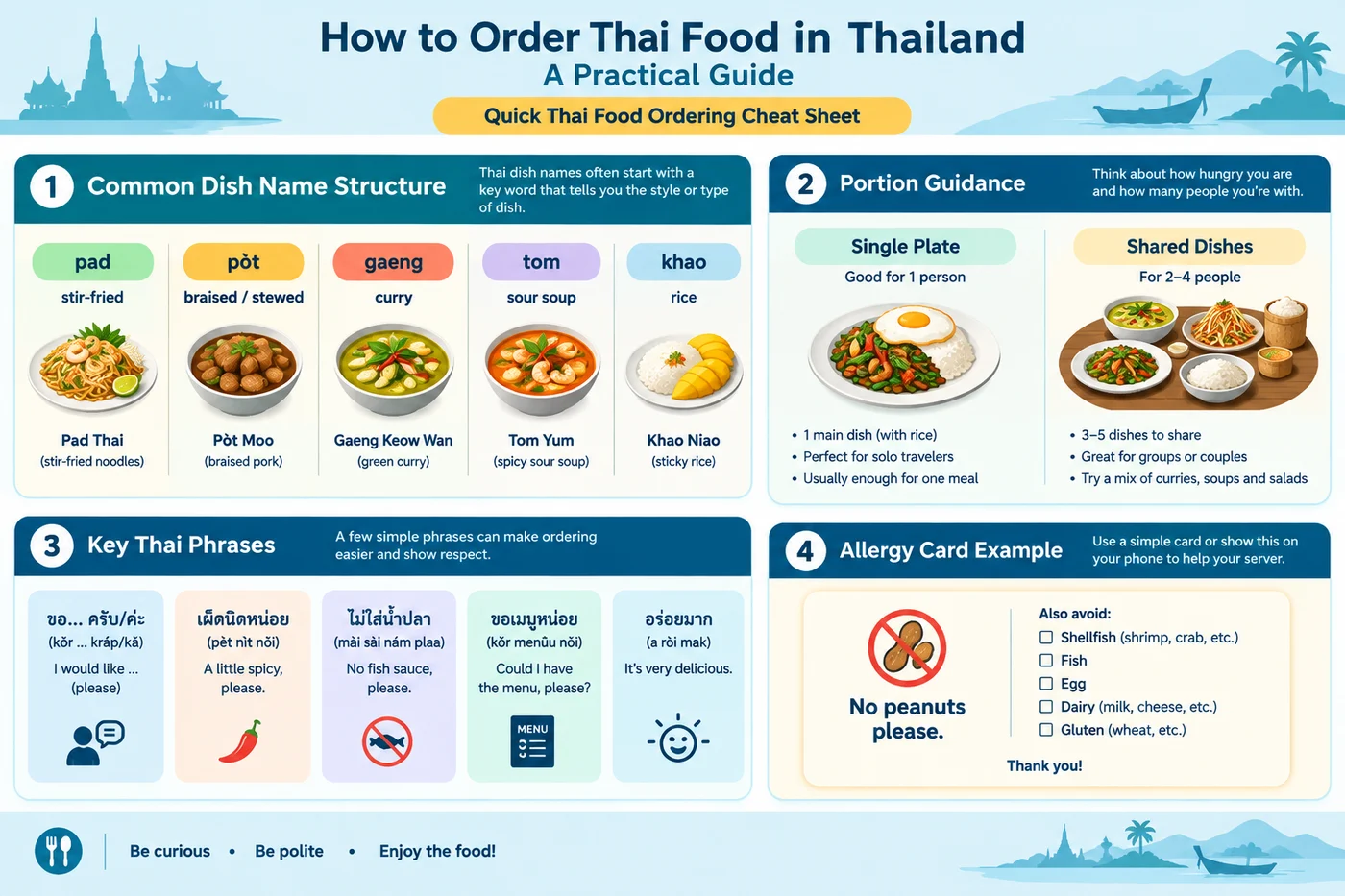
Thai dish names commonly follow a pattern: cooking method + main ingredient. Examples: pad (ผัด) = stir‑fry (pad thai), tom (ต้ม) = soup (tom yam), gaeng/kaeng (แกง) = curry, khao (ข้าว) = rice dishes. Look for modifiers: gai (ไก่) = chicken, moo (หมู) = pork, pla (ปลา) = fish, talay (ทะเล) = seafood. Many dishes contain nam pla (น้ำปลา, fish sauce), kapi (กะปิ, shrimp paste) or chicken/seafood stock — don’t assume 'vegetarian' means vegan unless the menu states it. In tourist areas you’ll often find brief English descriptions; elsewhere a translation app or a photo of the dish helps. For regional differences, expect Bangkok to offer wide variety and international options; Chiang Mai to feature Lanna specialities; Isaan (northeast) to be spicier with grilled meats and som tam; southern Thailand to use more coconut milk and seafood. These are general trends, not rules.
How to order Thai food in Thailand — step-by-step
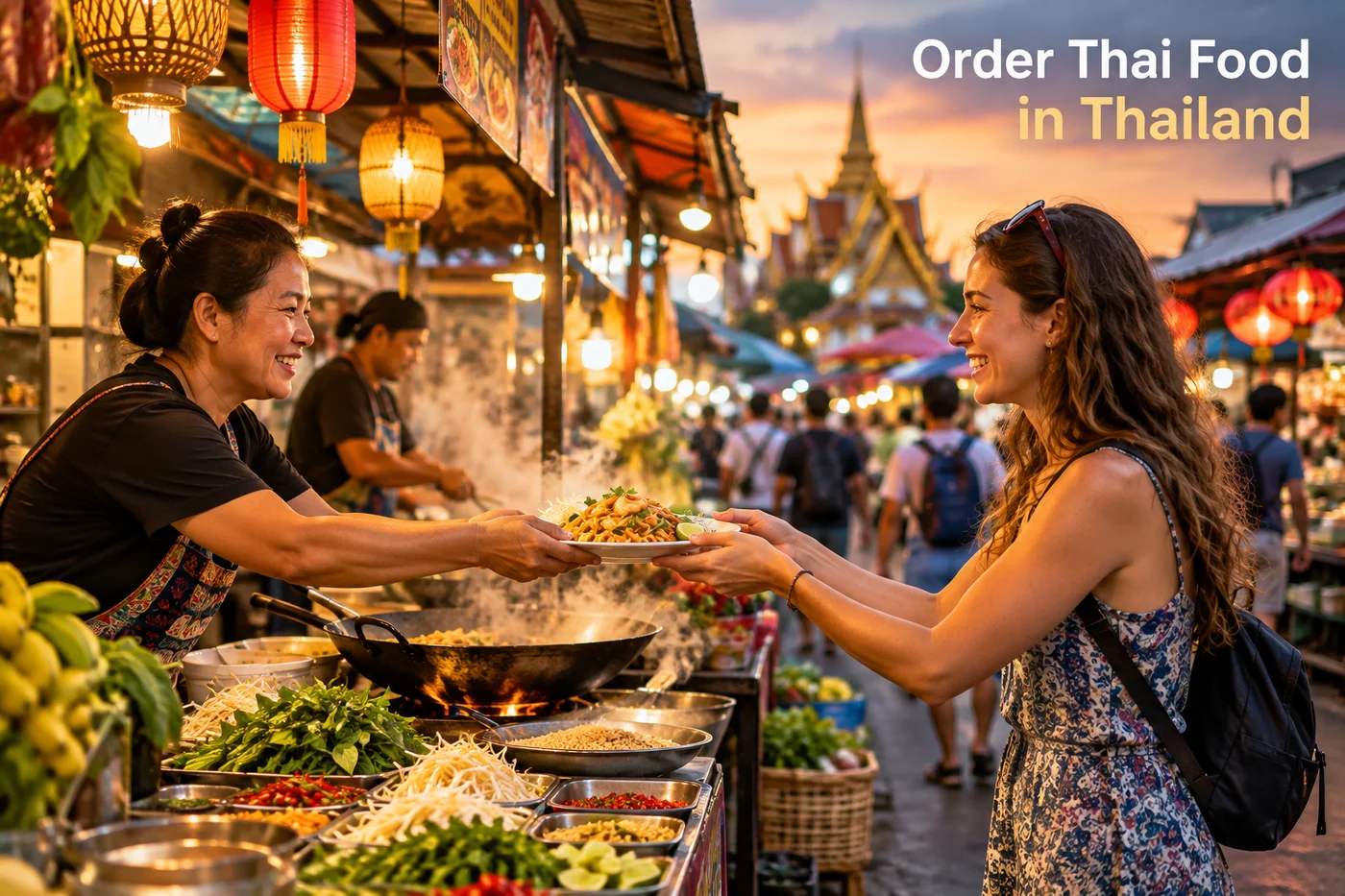
Start with a polite pattern in restaurants: ขอ (kɔ̌ɔ) + [dish name] + ครับ/ค่ะ (kráp/kâ). Example: "ขอผัดไทยครับ / kɔ̌ɔ pàt thai kráp" (May I have pad thai). At street stalls vendors expect pointing and a short command: เอา (ao, “I’ll take this”) + number/classifier — e.g., point + "เอาจานนี้หนึ่งครับ / ao jàan níi nèung kráp". For groups, say how many plates or ask for extra rice: "ข้าวสวยหนึ่งถ้วย/สองถ้วย (kâao sŭay nèung tûai / sǎawng tûai)". Need a takeaway box? Ask: "ขอห่อกลับครับ/ค่ะ (kɔ̌ɔ hòr glàp kráp/kâ)". Sample dialogues: 1) Single plate at stall: (point) "เอา 1 จาน ครับ / ao nèung jàan kráp." 2) Small group in a restaurant: "ขอแกงเขียวหวานหมูหนึ่ง กับผัดผักรวมสอง และข้าวสวยสองครับ / kɔ̌ɔ gaeng khǐiao wăan moo nèung gàp pàt phàk ruuam sǎawng láe kâao sŭay sǎawng kráp."
Portion sizes, sharing and regional menu tips
Thai dining is usually family‑style: people order several dishes to share with steamed rice. For two people, 2–3 dishes plus rice is typical; for four, 3–5 dishes. Portions at street stalls are often a single serving; restaurant portions vary — if unsure, ask "จานใหญ่ไหม? / jàan yài măi?" (Is that a large plate?). Regional tips: Bangkok menus are diverse and may include English; Chiang Mai highlights northern salads and grilled meats; Isaan is known for bold, spicy flavours (start with 'a little spicy' if you prefer milder food); southern cuisine uses coconut milk and curries with pronounced heat. When ordering for a group, name each dish and how many plates of rice, and consider ordering one mild dish for those who prefer less spice.
Spice control, vegetarian, halal and allergy phrases
Control heat with short phrases: เผ็ด (pèt = spicy), เผ็ดนิดหน่อย (pèt nít‑nòi = a little spicy), ไม่เผ็ด or ไม่ใส่พริก (mâi pèt / mâi sài phrík = not spicy / don't add chilis). To ask for no fish sauce: "ไม่ใส่น้ำปลา (mâi sài náam‑plaa)". Vegetarian/vegan requests are best supported by a written card listing exact exclusions: sample card lines — "ฉันเป็นมังสวิรัติ — กรุณาไม่ใส่น้ำปลา กะปิ และน้ำซุปที่ทำจากเนื้อสัตว์" (I am vegetarian — please do not add fish sauce, shrimp paste or stock made from meat). For allergies, always carry a short Thai card: e.g., "แพ้อาหารทะเล (shellfish allergy) — ห้ามใส่กุ้ง หอย ปู ปลาหมึก" and show it to the cook. Verbal 'mâi pèt' is fine for spice, but do not rely on speech alone for serious allergies — ask staff to read the card and confirm.
Street stalls, safety, payment and tipping
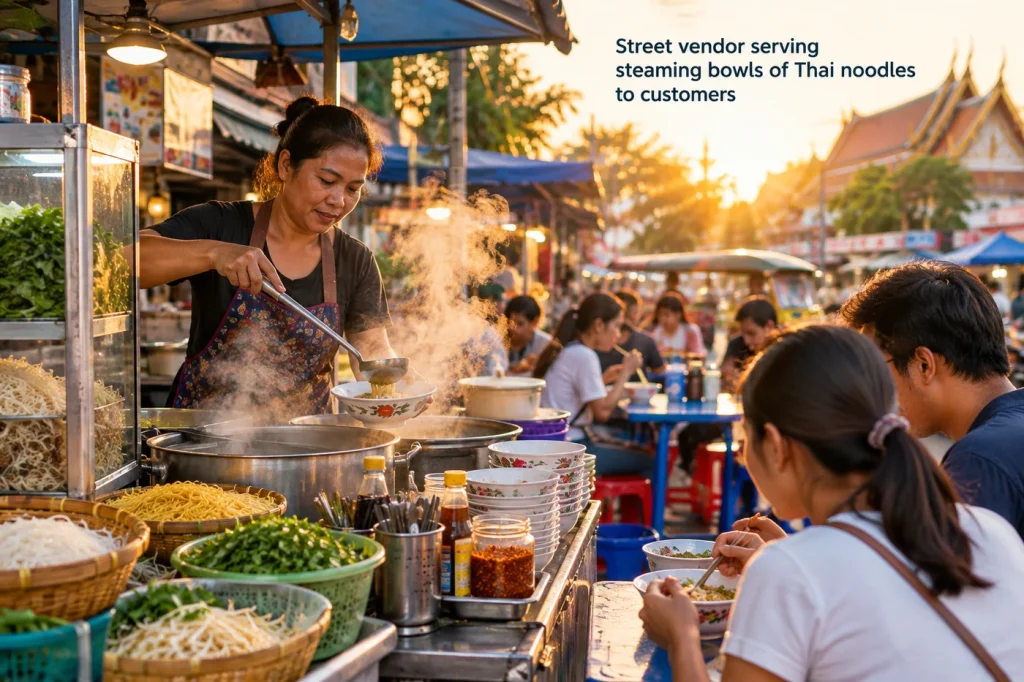
Street food is central to eating in Thailand — pick busy stalls that cook to order and serve hot food. Avoid raw shellfish, undercooked seafood and salads with unknown ice or tap water; follow CDC travel guidance on food and water safety (see sources). Cash (Thai baht) is essential for markets and stalls; many hotels and mid‑range restaurants accept cards but small vendors often do not. Carry small notes and change — vendors may not take 1,000 THB notes. Tipping is appreciated but not obligatory; rounding up the bill or leaving 20–50 THB at a restaurant is common. If you want leftovers wrapped, ask for "ขอห่อกลับ (kɔ̌ɔ hòr glàp)".
Sample ordering scripts and a quick cheat sheet
Keep these short phrases accessible on your phone or printed: – ขอ + dish + ครับ/ค่ะ (kɔ̌ɔ + dish + kráp/kâ) — 'May I have…' – เอา + number + จาน (ao + nèung + jàan) — 'I'll take one plate' (street stall) – เผ็ดนิดหน่อย / pèt nít‑nòi — 'a little spicy' – ไม่ใส่น้ำปลา / mâi sài náam‑plaa — 'no fish sauce' – ขอห่อกลับ / kɔ̌ɔ hòr glàp — 'Please wrap to take away' Also keep an allergy card in Thai and show it to staff; when in doubt, ask the vendor to point out ingredients or show a photo of the dish before ordering. For more dining picks and specific restaurant recommendations, see our Bangkok restaurant guide on HotelForU.net.
Practical Tips
• Carry a small written allergy/diet card in Thai and show it to the cook.
• Use 'ขอ' + dish + 'ครับ/ค่ะ' in restaurants; point and use 'เอา' at stalls.
• Order 2–4 dishes plus rice for small groups; ask for 'a little spicy' to start.
• Bring cash for stalls and small restaurants; avoid drinking tap water or ice from uncertified sources.
• Save a photo of key phrases on your phone for quick access.
Important Considerations
• Don’t rely solely on spoken requests for serious allergies — use a written card and reconfirm.
• 'Vegetarian' on menus may still include fish sauce or stock unless the kitchen confirms otherwise.
• Prices, menu availability and card acceptance vary by region and vendor type.
Planning more of your trip? Browse our
Thailand Food & Restaurant Guides
for more practical Thailand food and dining information.
Final Thoughts
Ordering Thai food in Thailand is straightforward once you know the menu patterns, a handful of phrases and safety basics. With a short phrase card, a written allergy note and the simple scripts above you can explore street stalls and restaurants confidently — and taste Thailand with less worry.
Sources & Further Reading
- CDC Yellow Book — Thailand (travel health guidance)
- Jam Kham — Essential Thai phrases and menu guide
- BackpackThailand — Thai street food guide and phrases
Transport schedules, fares and operating rules can change. Always verify time-sensitive details with the official operator before travel.