
HOTEL GUIDE
Food Allergies and Dietary Restrictions in Thailand: A Practical Traveler’s Guide
This practical guide helps international travelers manage food allergies in Thailand: identify hidden allergens, use Thai allergy cards, reduce cross-contamination risk and handle emergencies.
If you have food allergies, arriving in Thailand raises practical questions: what ingredients to watch for, how to ask cooks to exclude items, and how to handle accidental exposure. This guide covers food allergies in Thailand with hands-on advice—hidden ingredients, where the highest cross-contamination risks are, essential Thai translations/allergy cards, what medication to carry, and steps to take in an emergency.
Key Takeaways
- Bring prescribed epinephrine autoinjectors (and a clinician’s letter); do not assume you can replace them easily in Thailand.
- Learn key Thai words and carry allergy cards in Thai script—fish sauce (น้ำปลา), shrimp paste (กะปิ), peanuts (ถั่วลิสง) are often hidden.
- Street food and small kitchens have high cross-contact risk; prefer international hotels, specialty restaurants or vegan/jay kitchens when allergy severity is high.
Food allergies in Thailand: hidden allergens to watch
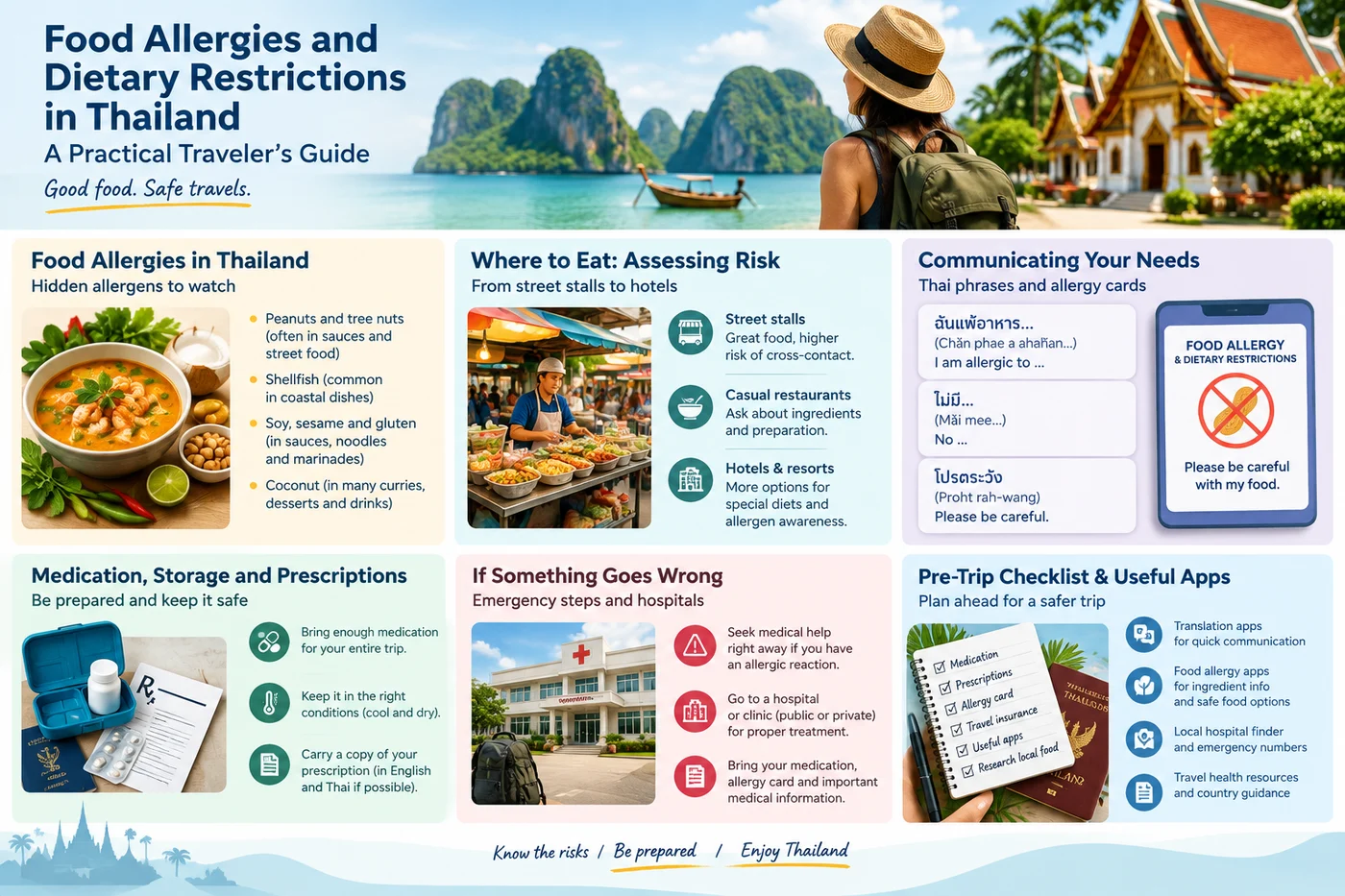
Thai cooking relies on several strong-flavor ingredients that are frequently used across dishes and condiments. Watch for:
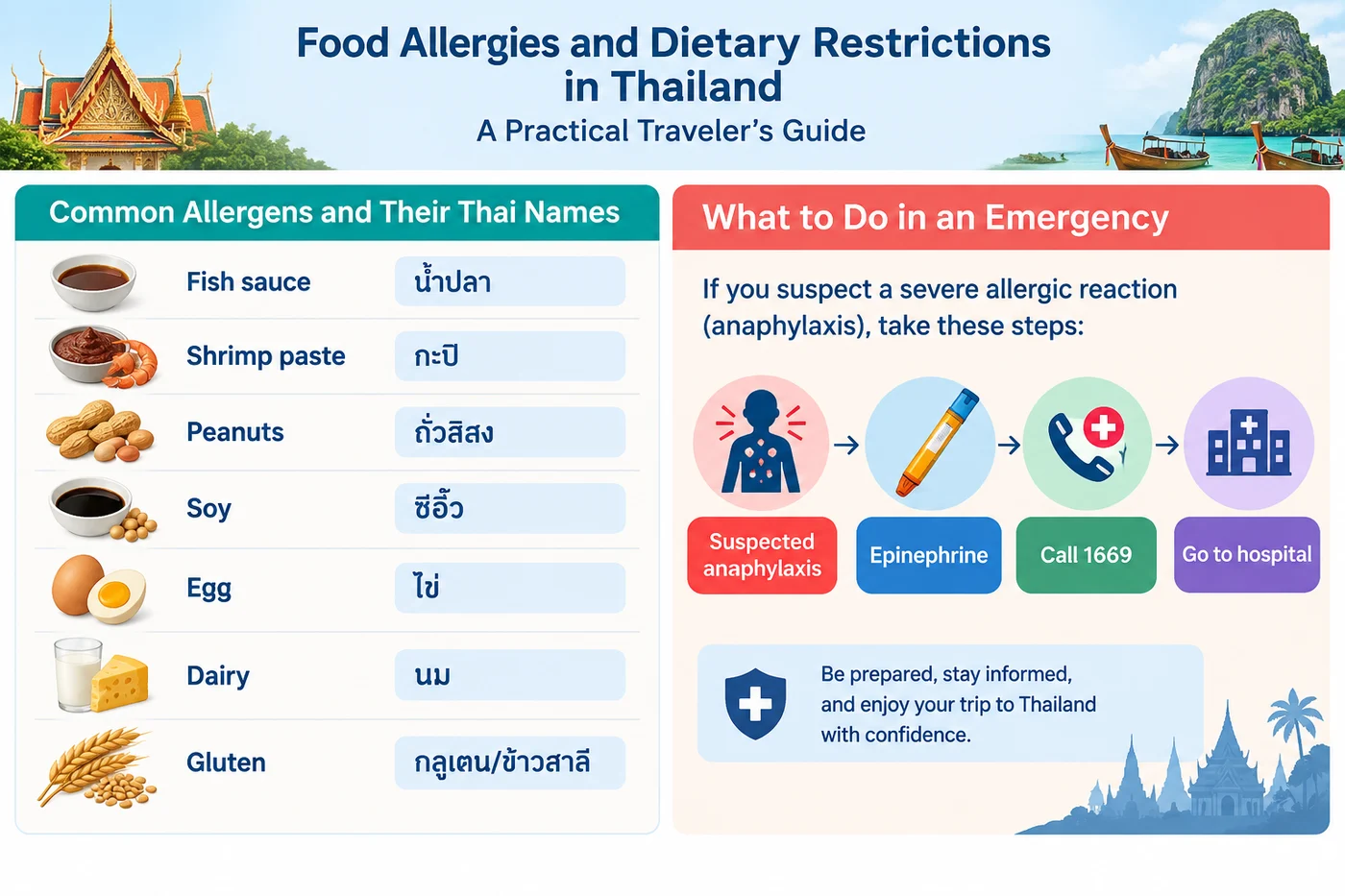
- Fish sauce (nam pla — น้ำปลา) and shrimp paste (kapi — กะปิ): foundational in stir-fries, soups, salads and dipping sauces. These can be “hidden” even where taste seems mild.
- Peanuts (ถั่วลิสง): used whole (Pad Thai toppings), crushed in sauces, and as garnishes.
- Shellfish and oyster sauce: common in noodle dishes and stir-fries.
- Soy and soy sauce: used in marinades and sauces.
- Eggs and dairy: eggs are common in street omelets and fried rice; dairy is less common but appears in some desserts and Western-style menus.
- Gluten (wheat): present in soy sauce, some noodles and breaded items.
Because recipes vary regionally and by vendor, never assume a dish is safe. Prepackaged foods have some labeling rules (Thai FDA), but freshly prepared food in restaurants and markets is not required to list allergens.
Where to eat: assessing risk — street stalls to hotels
Different venues carry different levels of risk. Street stalls and market vendors often share woks, oil and utensils—cross-contact is common. Small family restaurants may also pre-mix sauces or reuse oil. For travellers with severe allergies, safer choices are:
- Hotel restaurants and international chains: better language support and separate prep areas in many cases.
- Higher-end Thai restaurants: more likely to accommodate and explain ingredients.
- Dedicated vegan or ‘jay’ kitchens: no animal products and often clearer ingredient control, but confirm peanut/soy handling.
If you eat at a street stall: ask the cook to prepare food fresh in a separate pan, request no garnish/sauces, and watch the food being cooked. If the vendor seems uncertain or unable to guarantee separation, skip the dish.
Communicating your needs: Thai phrases and allergy cards
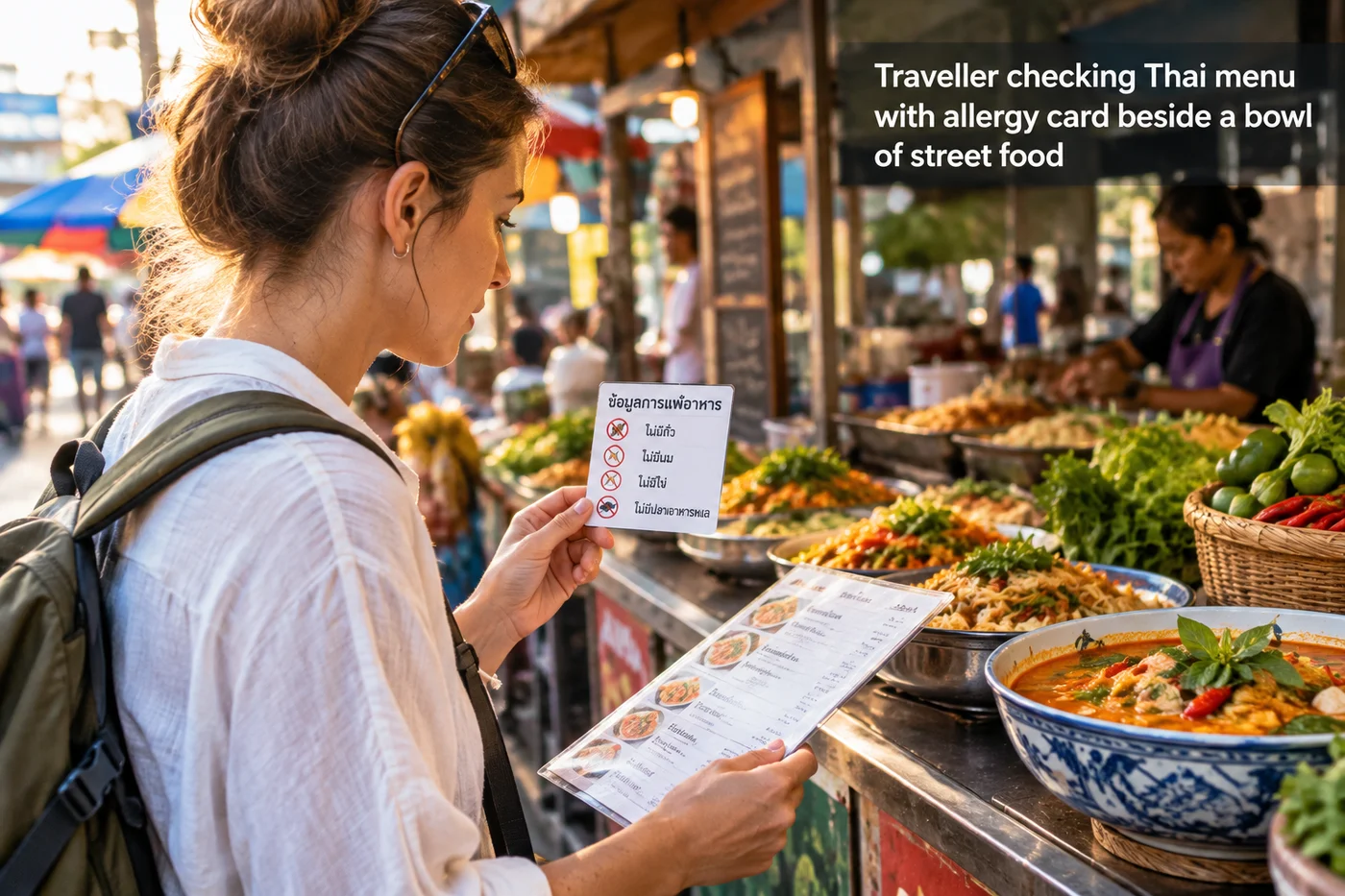
Always carry a printed allergy card in Thai script listing specific ingredients and derivatives—this is the most reliable way to communicate. Example lines to include:
- I am allergic to: (list allergens) — ฉันแพ้: [list]
- Do not give me: fish sauce (น้ำปลา), shrimp paste (กะปิ), peanuts (ถั่วลิสง), soy (ซีอิ๊ว), egg (ไข่), milk (นม), wheat/gluten (ข้าวสาลี/กลูเตน).
Short spoken phrases to practice:
– 'ฉันแพ้อาหารทะเล' (chan pae ahaan thalay) — I am allergic to shellfish.
– 'ไม่มีถั่วลิสงได้ไหม' (mai mee tua-lisong dai mai) — Can you make this without peanuts?
Use translation apps for menus but rely on your printed card for cooks. Keep cards laminated and carry several copies (one in your wallet, one in your phone case).
Medication, storage and prescriptions
Bring your prescribed medications from home and a clinician’s letter including diagnosis and prescriptions. Epinephrine (adrenaline) is first-line treatment for anaphylaxis; branded autoinjectors (EpiPen-style) are not reliably available over-the-counter in Thailand, and replacement often requires a clinic visit or hospital prescription. Because this can change, treat availability as variable and plan to travel with at least two autoinjectors if prescribed.
Temperature protection: Thailand’s heat can degrade medications—use an insulated pouch or cooler pack for autoinjectors and check expiry dates frequently. Also pack antihistamines, oral steroids if prescribed, and clear instructions for use.
If you need to replace medication locally, contact an international clinic or hospital; major private hospitals (e.g., Bumrungrad, Bangkok Hospital, Samitivej) provide English-language services and can advise on prescriptions and emergency supplies.
If something goes wrong: emergency steps and hospitals
For suspected anaphylaxis act immediately:
1. Use your epinephrine autoinjector without delay.
2. Call Thailand’s national emergency number: 1669. (This is the national EMS number; procedures and response times vary by location.)
3. Get to a hospital or call EMS for transport—major private hospitals in urban areas offer international patient services and English-speaking staff.
If you cannot use an autoinjector yourself, instruct companions to give intramuscular epinephrine and call 1669. Confirm your travel insurance covers emergency care and evacuation before you go. For non-life-threatening allergic reactions, contact a local clinic or your hotel’s concierge for guidance. For planning, see HotelForU’s pages on hospitals and travel healthcare in Thailand to locate nearby international hospitals.
Pre-trip checklist and useful apps/resources
Before you travel:
- See your allergy specialist: review your action plan, prescriptions and travel medical letter.
- Pack: at least two epinephrine autoinjectors (if prescribed), antihistamines, a translated allergy card, and photos of your medications.
- Research: identify nearby hospitals at each destination (HotelForU destination pages are helpful).
- Download apps: translation apps that work offline, local maps, and any allergy-specific apps (check app store reviews).
Useful resources: Thailand’s emergency number 1669 (Thailand.go.th) and current Thai FDA notifications on food labelling for prepackaged goods. Remember regulations and medicine availability can change—verify details before departure.
Practical Tips
1) Carry laminated Thai-script allergy cards and show them before ordering. 2) Prefer freshly cooked items made to order and ask for separate cookware; avoid shared-plate snacks. 3) Keep your epinephrine accessible (not in checked luggage) and protect it from heat. 4) Photograph labels on packaged foods; if in doubt, don’t eat it.
Important Considerations
Do not rely on menu translations or assumptions about dishes—recipes vary. Epinephrine autoinjector availability and medication rules can change; bring your prescribed supplies and a clinician’s letter. For severe allergies, avoid high-risk food venues (busy street stalls) when possible.
Planning more of your trip? Browse our
Thailand Food & Restaurant Guides
for more practical Thailand food and dining information.
Final Thoughts
Managing food allergies in Thailand is practical with preparation: bring prescribed meds, use Thai-script allergy cards, choose lower-risk dining options and know emergency steps. With those precautions you can enjoy Thai food more safely—always prioritise rapid treatment for reactions and contact local emergency services (1669) if anaphylaxis is suspected.
Sources & Further Reading
- Thailand Government Public Relations — Emergency contact numbers (1669)
- Thai FDA / Ministry of Public Health — Food labelling notification (English PDF)
- Doctor Bangkok — Severe food allergy and travelling to Bangkok
- Bumrungrad International Hospital — International services
Transport schedules, fares and operating rules can change. Always verify time-sensitive details with the official operator before travel.