HOTEL GUIDE
The Traveler’s Guide to Thai Curries: Types, Regional Variations and How to Order
Identify the most common Thai curries, learn regional differences and simple phrases to order or modify dishes when travelling in Thailand.
Thai curries are a cornerstone of Thailand’s food culture — a fast way to understand local ingredients, regional influences and what to expect at street stalls and sit-down restaurants. This guide decodes the most common curries, how they taste, where to try authentic versions, and exactly what to say when you want less heat or need to avoid shrimp paste or peanuts.
Key Takeaways
- Thai curries fall into coconut-milk–based and non–coconut categories; ingredients and heat vary by region and cook.
- Know common allergens (shrimp paste, fish sauce, peanuts) and carry a Thai allergy card; ask for 'mai sai' (don’t add) when needed.
- Use simple Thai phrases or point to script to control spice and get authentic regional versions — street stalls, Muslim kitchens and northern restaurants each showcase different curries.
What makes a Thai curry?
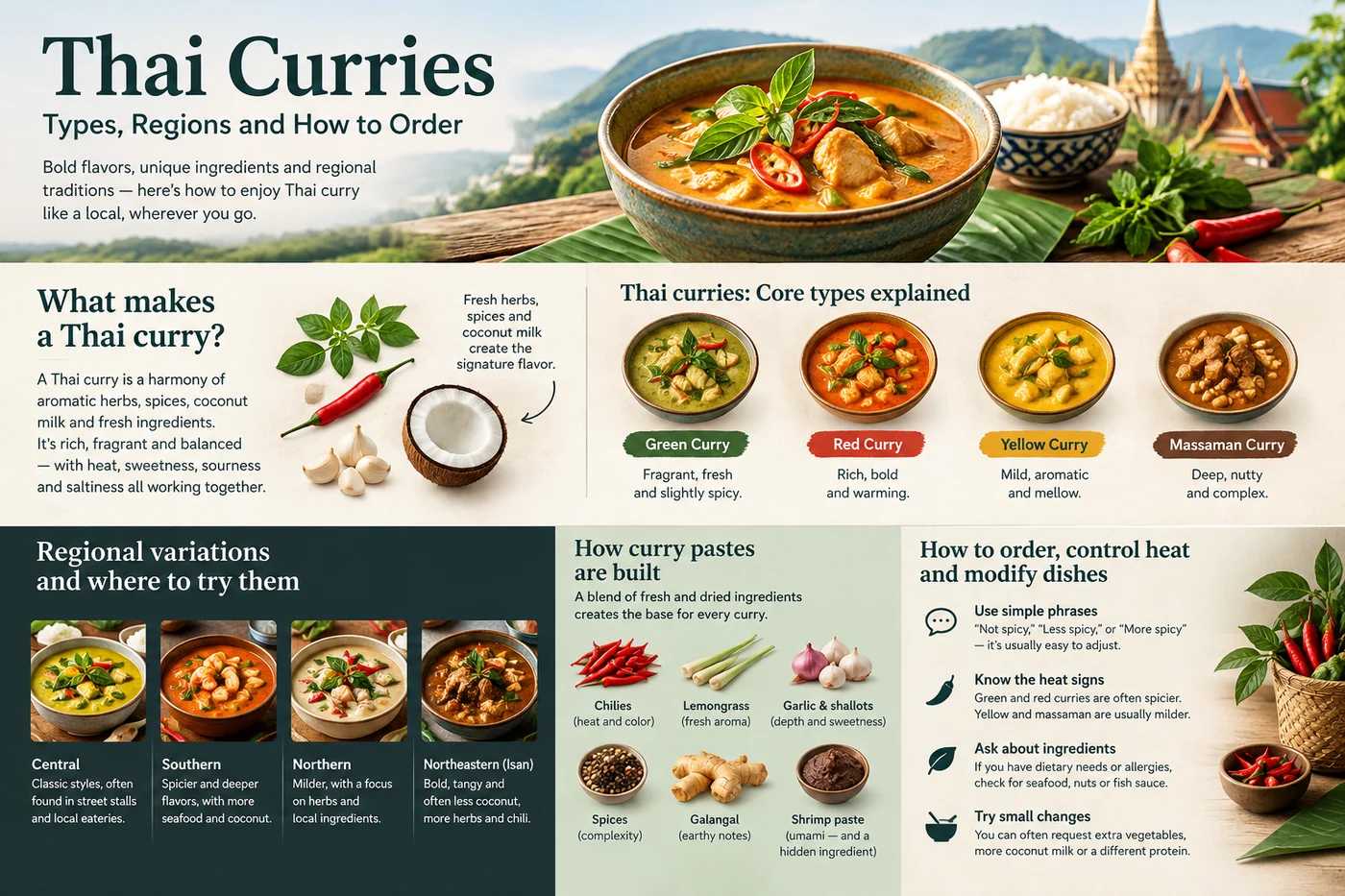
A Thai curry (kaeng/gaeng) is less a single recipe than a flavour formula: a fresh paste of aromatics (chilies, garlic, shallot), galangal, lemongrass and kaffir lime, plus an umami base—usually shrimp paste (kapi) and fish sauce—and then either coconut milk or nothing. Curries balance hot, salty, sweet and sour; coconut-milk–based stews like green and Massaman are rich and creamy, while southern and sour styles (kaeng som, gaeng pa/jungle curry) can be fiery and sharp without coconut.
Thai curries: Core types explained
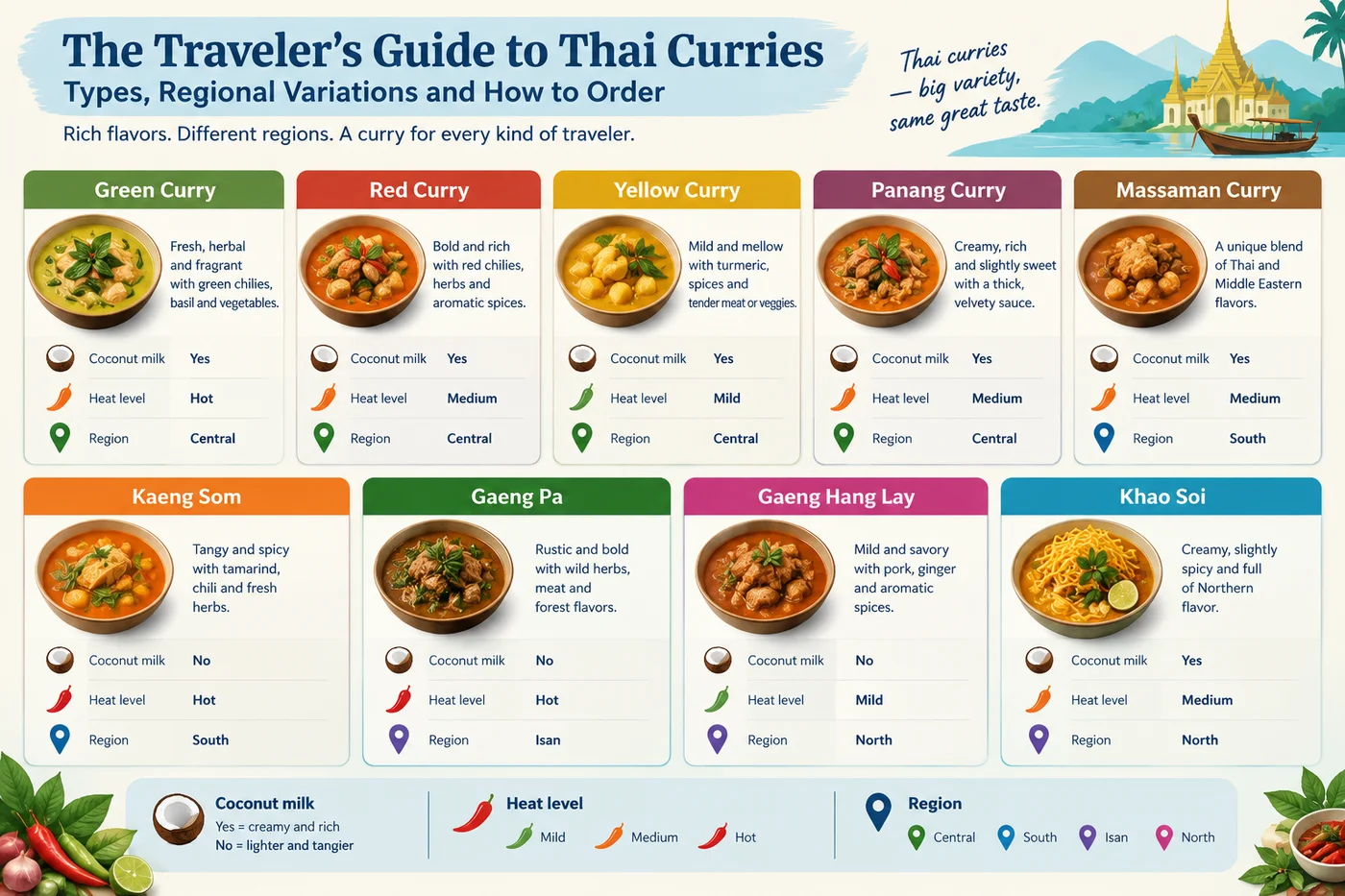
Green (Kaeng khiao wan): Bright, herbaceous curry made with green chilies, herbs, galangal and coconut milk. Often uses Thai eggplant and basil; commonly one of the hotter coconut curries, but heat varies.
Red (Kaeng phet): Made from dried red chilies and similar aromatics; rich, slightly smoky, usually medium to hot. Good with chicken, beef or seafood.
Yellow (Kaeng kari): Influenced by Indian spices (turmeric, cumin); milder and sweeter, often featuring potatoes and chicken; a travel-friendly option for lower spice tolerance.
Panang: A thicker, slightly sweeter curry with ground peanuts and fragrant kaffir lime zest; less soupy, often served with slices of lime leaf.
Massaman: A stew-like curry with warm spices—cinnamon, cardamom, cloves and cumin—reflecting Malay/Indian/Persian influences. Typically milder and frequently found in Muslim-run kitchens in the south and historic trading ports.
Kaeng som (Thai sour curry): Not made with coconut milk; tangy from tamarind or bilimbi and often loaded with local fish and seasonal vegetables.
Gaeng pa (jungle curry): From the forested central/northern borderlands; very hot, watery rather than coconut-based, with wild herbs and minimal dairy.
Northern specials: Dishes like gaeng hang lay (Burmese/Shan-influenced pork curry) and khao soi (curry noodle soup) are unique to the north and use different spice palettes and techniques.
Regional variations and where to try them
North: Try khao soi and gaeng hang lay in Chiang Mai and surrounding provinces—look for northern restaurants and specialty stalls.
Northeast (Isan): Curries are often lighter on coconut and more influenced by grilled meats and sticky rice culture; markets and local eateries are best.
Central: Bangkok and the central plains serve a broad mix—coconut-based classics and refined variants in mid-range restaurants and food courts.
South: Expect bolder, hotter curries with Malay and Muslim influence. For Massaman and seafood curries, try Muslim-run eateries and coastal seafood markets. Street stalls, wet markets and southern family restaurants are ideal for authentic regional tastes.
How curry pastes are built (and hidden ingredients to watch)
Traditional pastes are made by pounding fresh herbs and spices by mortar and pestle. Key pantry words to know: galangal (kha), lemongrass (ta-khrai), kaffir lime leaf (bai makrut). Most pastes include shrimp paste (kapi) and dishes are often finished with fish sauce (nam pla). If you avoid seafood or shellfish, explicitly request 'mai sai kapi' (ไม่ใส่กะปิ) and 'mai sai nam pla' (ไม่ใส่ น้ำปลา). Peanut-containing curries (Panang, some Massaman recipes) should be avoided if you have nut allergies.
How to order, control heat and modify dishes
Simple Thai phrases: 'mai phet' (ไม่เผ็ด) = not spicy; 'phet nit noi' (เผ็ดนิดหน่อย) = a little spicy; 'mai sai prik' (ไม่ใส่พริก) = no chili. Pointing at a menu item and saying one of these is widely understood. Ask for condiments on the side (put prik nam pla — chilis in fish sauce — on the side).
For vegetarians/vegans: many curries use shrimp paste and fish sauce; ask for 'mai sai kapi, mai sai nam pla' and request tofu and vegetable broth if possible. Carry a short allergy/exclusion card in Thai to show kitchen staff for absolute clarity.
Where to order each curry: street-stall green/red curries in Bangkok, khao soi in Chiang Mai, Massaman in Muslim-run southern or central restaurants, kaeng som at seaside markets where local fish is fresh.
Practical Tips
Ask for 'phet nit noi' to reduce heat and insist on condiments separate. Carry a Thai allergy card stating ‘no shrimp paste’, ‘no fish sauce’, or ‘no peanuts’. For authentic finds, combine market stalls with at least one well-reviewed regional restaurant—HotelForU's Bangkok street-food guide is a good internal link opportunity.
Important Considerations
Many curry pastes contain shrimp paste and fish sauce—don’t assume vegetarian or halal unless confirmed. Spice levels are subjective; ‘not spicy’ in Thailand can still be hot. Origin stories (e.g., Massaman) are debated—appreciate regional influence without definitive claims.
Planning more of your trip? Browse our
Thailand Food & Restaurant Guides
for more practical Thailand food and dining information.
Final Thoughts
Thai curries reward curiosity: sampling a few across regions gives a quick lesson in local ingredients and history. Keep a short Thai phrase list and an allergy card on your phone, start with milder options if you’re sensitive to heat, and seek out local markets and specialist restaurants to taste truly regional versions of Thai curries.
Sources & Further Reading
- Tourism Authority of Thailand (TAT) – Much‑loved, must‑eat dishes from different regions
- OutThailand – Guide to Massaman and Thai curries
- Eat Walk Talk – How to order Thai food (phrases and tips)
- NDTV – Background on Massaman curry influences
Transport schedules, fares and operating rules can change. Always verify time-sensitive details with the official operator before travel.