HOTEL GUIDE
Tipping in Thailand: Practical Restaurant & Payment Guide
Clear, practical advice for international travellers on tipping, service charges and how to pay in Thai restaurants, food stalls and markets.
Should you tip in Thailand? Short answer: not strictly required, but appreciated in many places. This guide explains local tipping customs, how service charges and VAT appear on bills, and the best ways to pay — cash, card or QR — so you won't face awkward moments at restaurants, food courts or markets.
Key Takeaways
- Tipping in Thailand is optional: small change or rounding-up is common; larger tips are reserved for exceptional service or higher-end venues.
- Look for 'NET' (no extra) or '++' (service charge + VAT); service charges are often pooled and taxed, not always direct pay to one server.
- Carry some small baht for markets and street food; use cards at big venues, choose THB to avoid DCC, and use PromptPay/QR where available.
Reading the bill: NET, ++ and how charges add up
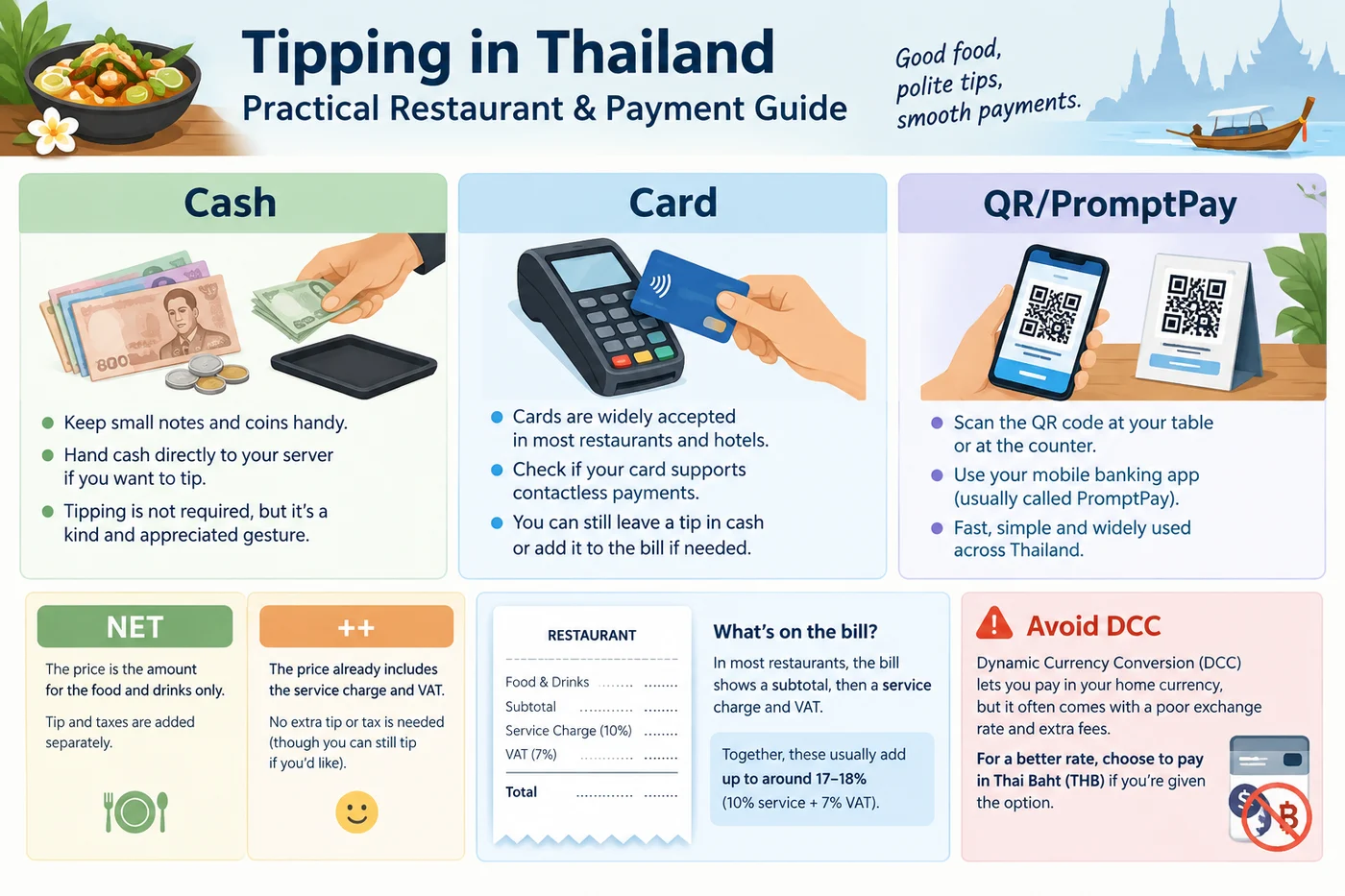
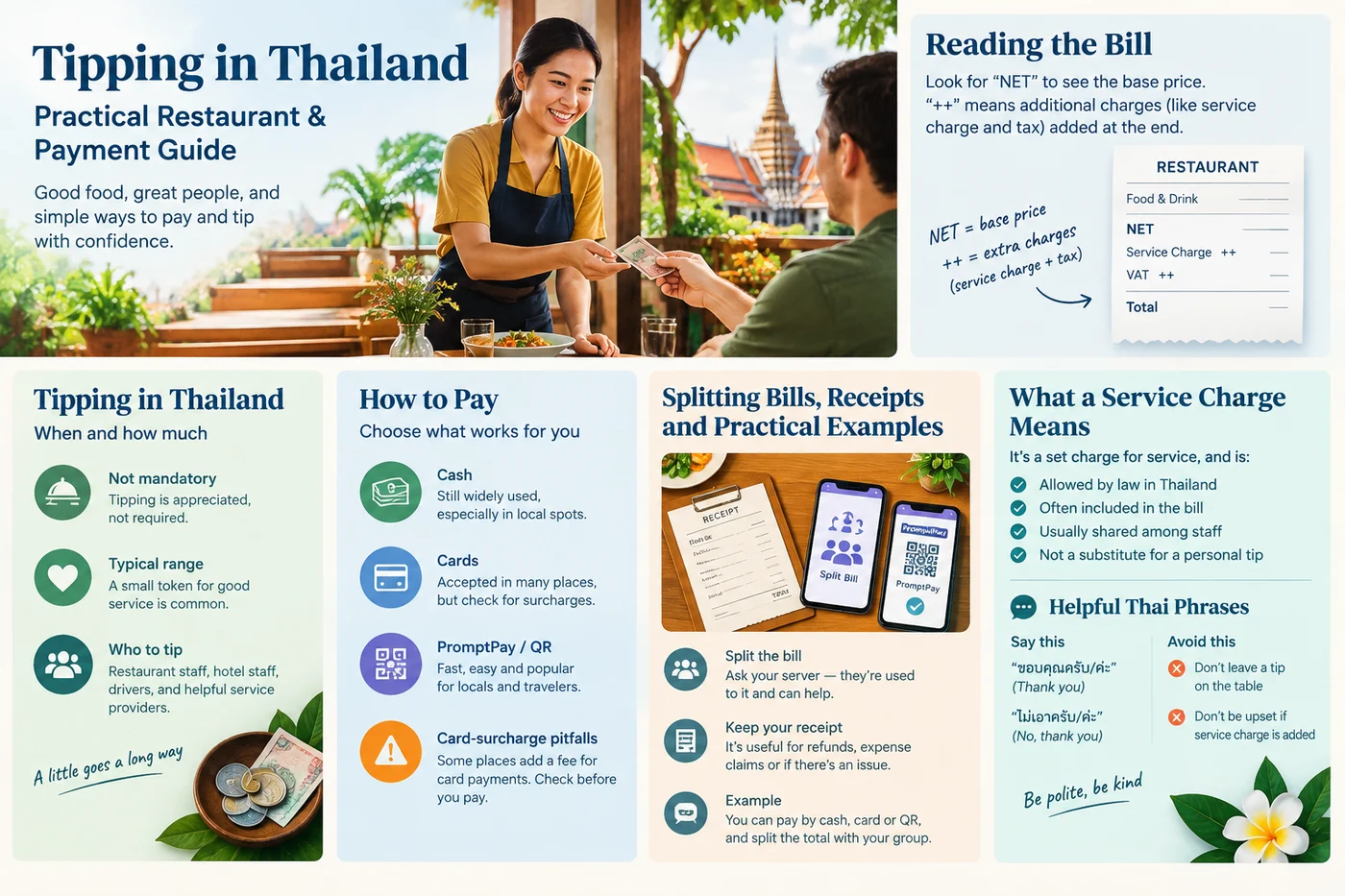
Thai menus and receipts use a few shorthand signs you should recognise. If a price is marked NET it usually means tax and service are included. If you see ++ (for example 200++), expect a service charge (commonly 10%) and then VAT. Because VAT is applied after service in many receipts, the final uplift is often roughly +17–18% versus the printed price. The current effective VAT rate is 7% (this reduced measure has been extended through 30 September 2027; check for updates if you travel later). When a 10% service charge appears, remember it is commonly collected and managed by the business and treated as taxable income — it may not be a direct cash tip to an individual server.
Tipping in Thailand: When and how much
Tipping in Thailand varies by context — it’s optional rather than mandatory. Practical, widely used guidelines: – Street food & markets: usually no tip expected; pay the amount and keep small change for rounding or a few baht as thanks. – Casual cafés and food courts: rounding up or leaving coins is common. – Sit‑down restaurants: if no service charge appears, a 5–10% tip for good service is appreciated; if ++ is on the bill, extra tipping is optional. – Fine dining & hotel restaurants: rounding up or 5–10% when no service charge; larger tips for exceptional service. – Bars and taxis: round up or leave 10–20 THB; for taxis, round to a convenient amount. – Room service, porters and guides: small notes (20–50 THB for porters; guides 100–300 THB per day if you’re very pleased) are common among tourists. These ranges are guidelines, not rules; local practice varies by region and venue type.
How to pay: cash, cards, PromptPay/QR and card-surcharge pitfalls
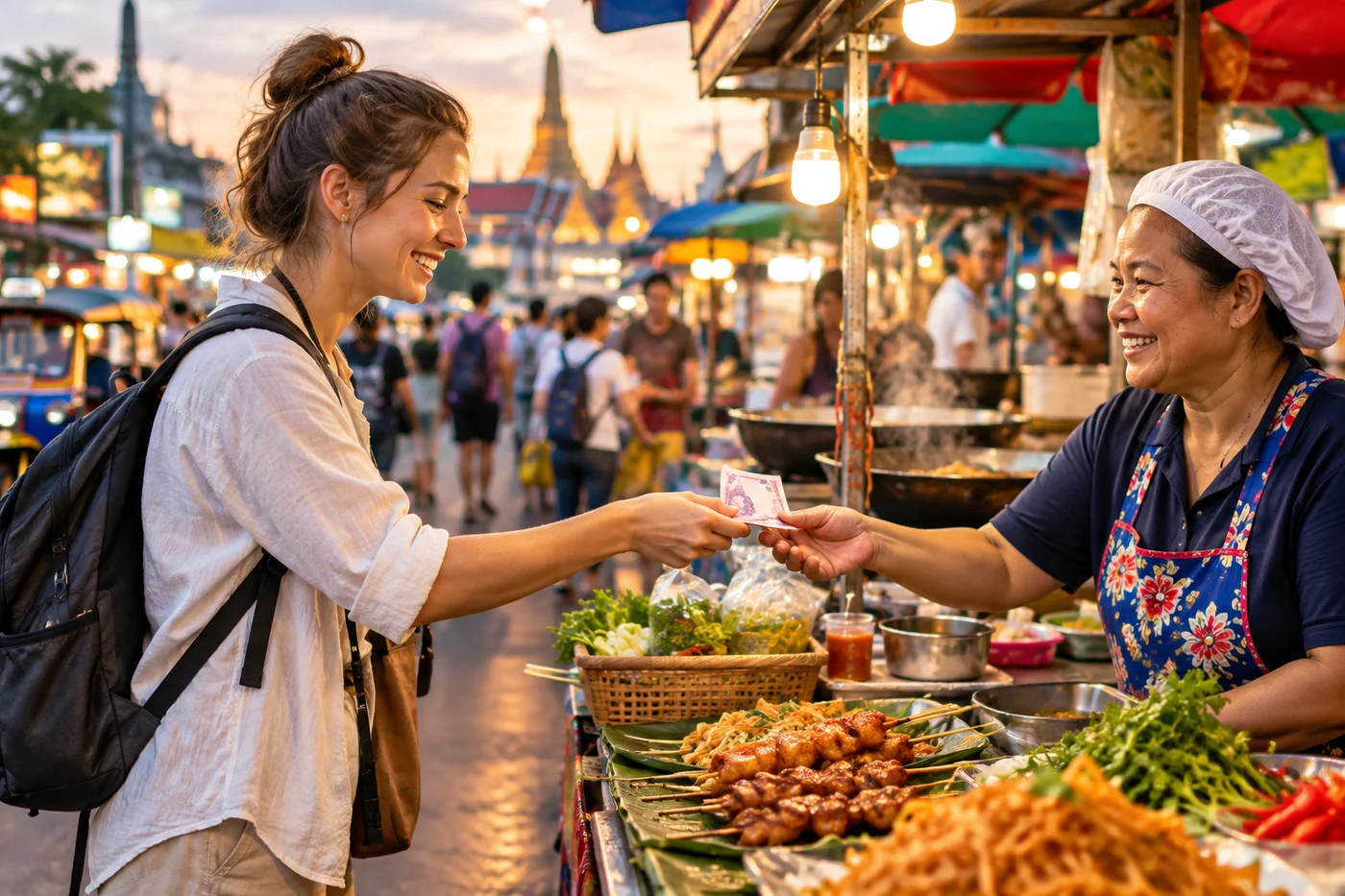
Cash remains king for street vendors, markets and many small cafés — carry small denominations (1, 5, 10, 20, 50 THB). Credit and debit cards are widely accepted at hotels, shopping centres and many restaurants, but not universal. When paying by card: always choose to be billed in Thai baht (avoid Dynamic Currency Conversion) and check the terminal and receipt for any merchant surcharge. PromptPay and Thai QR payments have spread quickly and are accepted even by many small merchants; they’re convenient but not guaranteed in every stall or rural area. ATMs are plentiful in cities but check your bank’s withdrawal fees and bring back‑up cash for remote areas.
Splitting bills, receipts and practical payment examples
Most mid‑range and high‑end restaurants can split a bill; tell staff at ordering or when you ask for the cheque. If a service charge is applied, splitting reduces the simplicity of leaving individual cash tips — guests commonly round per person or add a small extra when paying by card. Example approaches: – Group dinner without service charge: each person pays their share in cash or one card covers the bill and others transfer via PromptPay. – Group with ++ on the bill: split the total including service+VAT, and optionally leave small cash tips for servers. Keep receipts and check the printed amounts in case of mistakes.
What a service charge means (legal & practical points)
A listed service charge (often 10%) is a business-level surcharge. Thai tax rules treat these amounts as taxable income for the employer; many businesses pool service charges and distribute them internally. That means a service charge may not reach a single server directly. If you want to reward a specific staff member, leave a small cash tip and hand it to them directly.
Helpful Thai phrases and dos/don’ts
Handy phrases: – 'เก็บเงินด้วยครับ/ค่ะ' (kep ngoen duay khrab/ka) — 'Please bring the bill.' – 'รวมกัน/แยกบิลได้ไหม' (ruam gan / yaek bill dai mai) — 'Can we split the bill?' – 'ไม่ต้องทอน' (mai tong thon) — 'Keep the change.' Dos: carry small change, check receipts, choose THB for card payments. Don’ts: don’t assume tipping is expected everywhere; don’t force cash tips into a venue that already shows ++ without checking if you want to add extra.
Practical Tips
Carry small denominations for markets and taxis. If a bill shows ++, you don’t need to leave more unless service was outstanding. For cards, always pick THB to avoid DCC. Use PromptPay/QR when offered — it’s fast and common. Keep an ATM card backup and confirm withdrawal fees before you travel.
Important Considerations
VAT and some policies are time‑sensitive — the effective VAT rate is currently 7% (extended through 30 Sep 2027) and may change. Service charges are typically taxable and managed by the business; they are not guaranteed direct tips to staff. Card acceptance varies by venue; always have cash for street food and rural areas.
Planning more of your trip? Browse our
Thailand Food & Restaurant Guides
for more practical Thailand food and dining information.
Final Thoughts
Tipping in Thailand is simple in practice: be polite, carry small change, and match your tip to the setting. When in doubt, a small thank‑you coin or rounding up is always welcome — and if you want to reward excellent service, hand a cash tip to the person who helped you. For more on dining out and street food etiquette, see our Bangkok restaurant and street food guides on HotelForU.net.
Sources & Further Reading
- Tourism Authority of Thailand – Thai cuisine/visitor tips
- Thailand Revenue Department – Service charge guidance
- Bank of Thailand – PromptPay / Thai QR information
- Thairate – Explanation of ++ (service + VAT)
Transport schedules, fares and operating rules can change. Always verify time-sensitive details with the official operator before travel.